Map

Timeline

Showing posts with label Reflections. Show all posts

Saturday, March 21, 2015

Daughters of the Country

If we "unpack" the image of the voyageur into its essential qualities, we can find women to match virtually every criterion of the definition. In the sheer strength category, the Chipwyan women of Alexander Henry's journals could pull a loaded York boat of furs on rollers. For endurance, we have Métis hero Louis Riel's grandmother, Marie-Anne Lajimodière, who was thrown and dragged from her horse in her ninth month, and gave birth safely the next day. Lisette herself may be the record-holder for distance at speed: four thousand miles in eleven weeks.

Experienced voyageurs became guides, sharing their extensive knowledge of the canoe country. The Chipwyan Thanadelthur and the Shoshone Sacajawea, both "country wives" of fur traders, have entered the historical record as "guide and interpreter," as did many nameless women along the routes. David Thompson's Métis wife Charlotte, and their children, traveled with him on his famous mapping expeditions to the Rockies.

Were women restricted to "blue-collar" positions in the fur trade? Hardly. The Grignon sisters of Wisconsin had become two of the largest landowners in Green Bay by the 1840s. Juliette Kinzie, wife of an Indian agent, had the wherewithal to bring her piano with her in the canoe to Portage, Wisconsin. Arguably the most famous woman of the fur trade, Frances Anne Hopkins, was the bourgeoise wife of Governor Simpson, giving her name to Fort Frances, Ontario.

Madeleine LaFramboise of Mackinac spoke six languages and, when widowed, took over her husband's business so successfully that John Jacob Astor made her one of his agents. (Mme. La Framboise also had at least three husbands, giving her a running in the six-wives category, though there is no mention of running dogs.)

Native and Métis women were cultural voyageurs into the advancing European societies through their relationships with traders, their community and the land. And the enduring values of the voyageur's strong esprit de corps blend a respectful love of wilderness and freedom with the camaraderie of campfire, song, and paddle.

Walking In Her Moccasins

Any modern canoeist longs for the era of the voyageurs. The landscape itself evokes them. When the mist rises on Saganaga Lake, you can almost see the stern of the great canoes vanishing ahead of you in the fog. In the silent dip of the paddle, there is an echo of the rhythm of a song long vanished, yet recognizable as a heartbeat. In the call of wolf and loon, you know you can hear the voyageurs singing.

We all talk to the past. Women who value the voyageur mystique have a particular and dual challenge in seeking to reenact it. Modern, culturally European "woodswomen" identify with both halves of the fur trade split: we are white like the men and women like the natives. When we succeed in achieving this dual vision, it pops the fur trade into stereo.

The story of Daniel and Lisette Harmon has a unique ability to fuse the dualities that have been used for so long to define not only the fur trade era, but North American history itself. Strong, adventurous women long to put ourselves in the picture, to feel personally connected to a history in which we have long been taught we are invisible-or identified as male. When both men and women can identify with both Lewis and Clark and with Sacajawea, with both Lisette and Daniel Harmon, we will have gained new dimensions to the history of our continent and our place upon it.

We choose living history as a means to walk a mile in another's moccasins. I began Lisette's journey in 1988 with a passion for paddling and singing, those twin loves of the voyageur. Lisette has since given me a second language, a second country, three national awards, a major book and a CD, a passport to the past, insight into those not of my race or gender, and an enduring fascination with our great continent and its history of adventurous women. Lisette Duval has become my hero, and I am proud to walk in her moccasins.

A Legacy of Endurance

Lisette was a woman of endurance. She made an epic transcontinental journey while pregnant and nursing a newborn, as well as caring for two young daughters throughout the canoe trip. She bore fourteen children, ten surviving infancy, and outlived all but one. She was a devoted and beloved mother, and a "fair partner" all her days.

Lisette's patient, listening ear and keen eye for detail live on in her work. Harmon's journal, edited by the Rev. Daniel Haskell, includes a Cree dictionary that was made correct "by making the nice distinctions in the sound of the words, as derived from her repeated pronunciation of them."

Lisette's one surviving artifact is a quillworked leather shot bag in the Bennington Museum, acclaimed by art historians and anthropologists as one of the finest surviving examples of its genre. The stitches are tiny and close-set, the vegetable dyes rich and bright, the leather fine and supple, and the design exquisite. One can only imagine how many long summer days on canoe trips, and harsh winter nights from the Rockies to Vermont and MontrŽal, found her sewing by the fire, attentive to her task.

Sunday, March 08, 2015

Spirit of the Voyageur

The voyageurs are the heroes of their own tales. The short, stocky, tireless men are famous as the cowboys of the canoe country. According to legend, they have six wives and five running dogs, they can carry hundreds of pounds at a dogtrot, and they paddle three-ton canoes upstream. They can eat their weight in pemmican and drink a canoeful of rum apiece. Naturally, their exploits are larger than life. They are as large as their land.

Like other women of her era, Lisette is barely visible in "historic" accounts. Harmon's journal mentions her four times in sixteen years, and never by name. However, he writes in his appendix that it is a mark of respect among the Cree not to speak the name of a person under discussion, but to refer to them indirectly.

In the world of a man whose highest devotion was to family and community, there can be no higher state than the one Daniel accorded Lisette. She was "my cherished companion and the mother of my children." Yet beyond her role as wife and mother, Lisette's story brings to life a less stereotyped and much richer account of the multicultural height of fur trade society, at a time when most of the boundaries of North America were still being drawn. Lisette Duval was a real voyageur.

The voyageur symbolizes Canada and rivers with adventure, travel, exploration and discovery. Lisette's life spanned the continent from the Kootenays to Quebec. The rivers of the voyageur know no boundaries, and her journeys crossed the boundary waters again and again; her parentage, her marriage, and her family crossed boundaries of language, race and politics. The voyageur's symbol is the canoe, and like her craft, Lisette was born from native roots and raised to European commerce.

Voyageurs embody independence, and trade. Women of New France kept their names, owned property, and traded vigorously as North America's first businesswomen. Many a "Madame la Bourgeoise" interpreted, traded and managed her husband's accounts at the post during his extended field trips.

Voyageurs traded in needles, beads, pots and cloth used by native women, and like so many country wives, Lisette was skilled in the preparation of food, clothing and shelter that made liaisons with native women "the custom of the country." As the Métis children of native women and white trappers and traders, these women and thousands like them were literally daughters of the country: les femmes du pays.

Saturday, February 28, 2015

REFLECTIONS: Fort Astoria

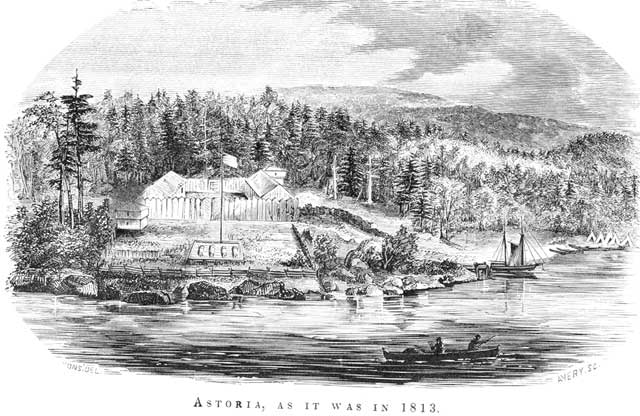
I'm here. I'm really here. At the mouth of the Columbia, and standing at the gates of Fort Astoria. For me, right now, it's 1811, and Lisette Laval Harmon is about to walk through that palisade gate to greet my old friend David Thompson, who has just arrived from Fort William on his first descent of the Columbia. He has yet to draw the famous David Thompson map that hangs in the Great Hall of NWC headquarters, where five years from now Lisette and Daniel will be married. It's all about to happen, the War of 1812, MacDonald's betrayal of Astor and Hunt, the fall of the Pacific Fur Company, the merger of the NWC and the HBC, Lisette's Journey back to Vermont, leaving her sister femmes du pays Charlotte Thompson and Marie Dorion in the pays d'en haut. It's all about to happen, and here I am, talking to my old friends in the fur trade.

Monday, July 14, 1997

Finding Lisette's Grave


Yesterday we found Lisette’s grave. Helen Meredith had wanted to help me look from the beginning, and having a Montreal native along really smoothed the way. I had written to Mount Royal Cemetery before and gotten a location number, G-11, which as it turned out wasn’t much help. We went in to the office and asked for Elizabeth Harmon d. 1862 and Abby Maria Harmon d. 1904, and the woman at the desk went in the back and came back in five minutes with a Xerox of two index cards. Yes, she was there, all right, and so were Mary and Calvin and their son Andy and a few others as well. Calvin Ladd had purchased the plot, but didn’t appear to be buried there. She gave us a plot map of that section of the cemetery, marking it on the main map. So off we went to G-1, Lot number 11.

Helen had done this before with her friend Jill’s relatives, so she knew how hard it was going to be. And we walked all around the edges of the section, which joins G-2 with just a dotted line between them. We parked at the top of a long grassy strip and hunted for about 45 minutes with no success. I was sure by now that either the family had died too poor for a stone or that there was a flat marker that had been grassed over. Poor Lisette, buried in an unmarked grave.


I went back to the car to check the order people had been buried. The first was a little girl, aged 4, in 1854. Was this why Calvin had bought the plot? She would probably only have a tiny marker. Next was Mary, Calvin’s beloved wife, in September of 1861. Surely she would have a gravestone? He was a well-to-do blacksmith, and had had enough money and connections to petition the courts on Lisette’s behalf in the 1840s. Had he come down in the world in twenty years? Hardly, because his son was listed in the 1870s as buried here, “brought from New York.” If they had had money to transport a body, surely there would be a marker. And the last one in 1904, Abby Maria, her daughter a suicide by drowning? We could hardly expect much of a marker for her, even though I knew she’d been brought here from Hull for burial. Someone must have cared, but how much? We weren’t finding them. I lined up the north arrows on the two maps for about the fourth time and tried to see where we could be going wrong. Helen was by now convinced we were in the wrong section and was methodically quartering the neighboring areas.


“Let’s go back to the office before they close and get the names of the other plots around her,” I said. “At least that way we can narrow it down.” So back we tooled to the office, where she obligingly gave us the family names of every plot surrounding the Harmons/Ladds. This time we took a different route, and were certain we had found G-1. I determined to walk all the way around the section, looking for any name we’d now got. Helen worked across the road, finding some Hollands (one of the names we’d got) but not any other neighbors. Probably not the right Hollands, we agreed, and moved on.


The edges of the G-1 section were clearly mapped out, and it didn’t match the line of the road on the main map. Could the roads have changed? I found myself at the top of the grassy ride we’d parked at earlier. Was this a “road” on the map? It certainly fit the shape of the section better than the asphalt one. I decided to walk down its edge to hunt for names. Here was the convex, then the concave curve: and right where it was supposed to be was a large, sarcophagus-style monument sporting a turbaned wasp’s nest and the name Holland. There were Hollands to the right of the Harmon plot, all right. I looked to the left.


And glory be, there she was. “Yeeeeee-HOUP!” My whoop of triumph would have done justice to a canoe arrival, but probably shocked the cemetery. I was standing in front of a polished red granite marker “in memorial to Daniel Williams Harmon, died at Sault-au-Recollet, Que, ##, 1843, to his wife, Elizabeth Laval, ##, and to their daughter Abby Maria, d. ## 1904.”

Thursday, August 25, 1988

REFLECTIONS: GREAT RIVER (Mississippi)

Friday, 25 August, 7:30 am Prairie du Chien, Wisconsin


The Great River is quiet today, green and blue against a flat sky. Why are summer rivers this flat, pure green and blue? In late summer, colors are distilled to pure tones before they bleed into the blended browns and bronzes of autumn. Russet, copper, gold: fall colors are shiny, metallic. The water then is cold and silver as the aluminum hull of a canoe. But today, while the summer sun slants low behind me, the water glides flat blue, leaf-green.

Just across the river there is Pike's Peak, Iowa: the bluff that overlooks the confluence of the Wisconsin and Mississippi Rivers. Last night Michael Douglass, Villa Louis Director, took us up there for an Adventure: the Great River by moonlight. In the dark I was disoriented at first. But the lights of Prairie du Chien across the water sorted me out, and I began to see.

The bluff is dim and silver in the moonlight, and below us the Great River pours away like a stream of time. Behind the black bulk of Wyalusing, the full moon pours its river of silver over the vast landscape. Time unrolls itself like a map, and I can feel the silver ribbons of rivers stretching into history. Whither away, o voyageurs?

To Itasca? Turn northward, upstream, where Zebulon Pike sought the source of the Mississippi in a clear spring. If a source is that stem of a a river that rises highest and farthest from its mouth, then, says John Madsen, the Missouri holds that title for the Mississippi, and this river below us is some other river entirely. But to find Itasca (from the Latin for "it is the head"), turn right from the mouth of the Wisconsin, then left below the falls of St. Croix past Fort Snelling, until you come to the place where the glaciers flung ten thousand lakes across the Minnesota muskeg like handfuls of silver coins. There you will find Itasca, one headwater among many.

To Québec? Turn back east up the Wisconsin, up Derleth's "River of a Thousand Isles," and trace the long homeward journey across the portage to the Fox, and down through Lake Winnebago to Green Bay. Paddle cautiously through "Death's Door" at the tip of the Door County peninsula, and steady your heavy load for the icy autumn waters of the Lakes. It's two months from here to Montreal, so touch your cap to the cliffs where Marquette lies in the Straits of Mackinaw, and call on your God to carry you through the North Channel of Georgian Bay past that greatest island, Manitoulin, Spirit Place. Bend to your paddle to climb the French River; breathe for a moment in the wind-whipped waters of Lake Nipissing; then hoist your heavy furs to the Mattawa's many portages. Bring out the high wine on Explorer's Point, for tomorrow you will turn right, down the Ottawa, and next week you will dance with your sweetheart in the taverns of Trois Rivières.

To St. Louis? Turn left from the Wisconsin's mouth, if you are Marquette, seeking your beloved Kaskaskia far to the south. For winter is coming on soon, and you are an ill man. Joliet knows this, as he knows the hostile tribes ahead who will care little for the trade goods you carry. They know only that you are one of the hated black robes, bearers of disease and supplanters of faith. But you will reach your cherished village this last time. Kaskaskia, downriver. Of all the missions you have founded, this one lies closest to your heart. From your sandbar at the Wisconsin's mouth, Father, the way lies clear. The Great River is your lifeline.

Michael's voice is suddenly quiet in the wide silence. "What was he thinking, Marquette?" We laugh quietly, and recite, all three together: "Today we entered the Mississippi with a joy I cannot express." Alain knows that line by heart, by now. All summer I have been retelling the story of how I tried to recreate that magic moment.

It was August, a year ago, and I strained to see the Mississippi for the first time, from a canoe. The massive bluffs drew closer, closer....crunch! Did Marquette hit this sandbar too? We piled out of the canoe into boot-high quicksand: "too thick to drink, too thin to plow." Tugging and hauling our aluminum canoe, we walked into the Mississippi.
Yet the moment was magic. The Iowa bluffs loomed massive, reminders of that great glacial Mississippi that once drained a continent in a roaring, churning yellow flood. Once these waters ran as yellow as the sandstone scarps where eagles perch. We idled a moment in the sandy slough, soaking it all in, then thrust the bow cautiously into the current of the Great River.

So too must Marquette have let the current take him. "Here we leave the waters that flow toward Quebec, to follow those that will lead us into strange lands." As I stand on this moonlit bluff, the current of history tugs me with living force. This silver ribbon below me flows timelessly toward the sea, gathering each of our lives to it as smoothly as a stream running over bare rock. Time spreads itself like a map, etched with the silver tracings of the rivers that bind the land into a living network.

So too is the land bound up in the lives of the paddlers. The Great River is our history, our future, and our eternal present. Here, in a silver ribbon of moonlight, I can reach far upriver into the foothills of time to where the campfires still glow with the warmth of song and story, a living human heart in the dark forest where the river begins.
Time unrolls itself like a map, and I can feel the silver ribbons of rivers stretching into history.

Friday, August 05, 1988

REFLECTIONS: Mattawa dedication ceremonies as a Canadian Heritage River

Friday, August 5, 1988, Samuel de Champlain Provincial Park, Ontario


Friday morning dawned cooler than we'd had in a while, and overcast. Good, said the voyageurs in their wool caps and sashes. Good, said John le Bourgeois as he donned his ruffled, stiff shirt, wool trousers and satin waistcoat. Good, said I in my tight bodice and layers of petticoats. "Come on," said Jean-Guy, Assistant Super, our avant (bowsman), a.k.a. "Papa Smurf" in his floppy cap. "Come on, Bourgeois, put on your coat and hat!" John, whose on-the-job garb for the last five days has been Hawaiian shorts and a tank top, just laughs. There's plenty of time.

It was a controlled flurry as the park trucks roared down to the staging area, a hurry-up-and-wait as the men hoisted the wickedly heavy canoe down the steep hill to the river and we debated taking a practice run. "There's time," said Louis. "But they're early," says Henri. "Do we really need to practice?" says Ti-Jean. "Aw, come on," says Etienne, our stout-hearted Jeff who began dubbing us all with French names this morning. His face is wreathed in a glowing grin at the prospect of recreating the life of his hero, Etienne Brulé, who at sixteen was only three years younger than Jeff when he made "the most famous left turn in history" up the Mattawa in 1610.

"So, come on, Etienne, let's practice," I say. "Are you going to drop me like Madame on La Vase Portage?" The scenario calls for the milieux, Jeff and Ky, to carry me out of the canoe to the ceremony platform, where I am to gather all the children together and lead them and the multitudes in the national anthem. I have mixed feelings about this plan. My feminist independence and long canoeing experience battle with my respect for historical accuracy and desire not to look foolish struggling out of a deep canoe in long skirts. There will be cameras, after all. So, they make a chair of their forearms and I sit, bustle-first, into it and swing my moccasins over the gunwale. After a few tries, we can pull it off reasonably gracefully. 

We settle onto the narrow seats to laugh about that earlier Madame, who like all the other early travelers had to cross the famous La Vase Portage further up the Mattawa. La Vase often translates as "mud," but Alain has informed us that it is no ordinary mud, but "slime," "ooze," sludge," and other malodorous liquids. The usual way to carry the bourgeois (and their wives) was "pickaback," but this portly dame thought it undignified and insisted on the more modest (and awkward) chair carry. Her weight proved too much for their forearms (or their patience) and suddenly --"oops! Sorry, Madame!" -- they dropped her in La Vase. History does not record her comments as she struggled, half-carried, half-stumbling, through the remaining two miles of waist-deep slime.

But Jeff and Ky have strong forearms and cheerful patience, and the bank is dry. Cautiously, we paddle out into the current for a practice run, trying unsuccessfully to conceal ourselves from the waiting twentieth-century crowd upstream. A green heron glides past the green bank, and a fish breaks the swirling surface with a gentle smack. Time glides backward like a river, and it is 1815, when the voyageurs' paddles swirled the pools of the Mattawa as smoothly as a song. This canoe rides high and empty of the weight of furs, but the sudden breeze smells as sharp and spicy-sweet as the spruce of the pays d'en haut. Upriver the paddles pull, upstream toward that earlier time. "C'est l'aviron qui nous mène, qui nous mène, c'est l'aviron qui nous mène en haut."

Suddenly the radio crackles from the truck on the bank, and we dive for cover. The ministers are coming, they are closer, they are here…GO! Paddles swirl and heads duck as we back out past the deadfalls, and the old song rings across the water to the rhythm of the paddles. "C'est l'aviron qui nous mène, qui nous mène, c'est l'aviron qui nous mène en haut." Doug, the gouvernail (sternsman), leans to his paddle in solemn joy, his years at Old Fort William carved into the contours of his bearded woodsman's face. Will from the District Office grins as devilishly as if he were paddling the chasse-galerie, the flying canoe that made a Devil's bargain with lonely voyageurs to transport them back to the bright lights of Old Québec from the bleak midwinter wilderness. Our barefoot milieux are doubled over in unholy glee; Jeff and Ky paddle as if their careers depended on it. Perhaps they do. 

Six-foot John is a study in pansy dignity as he drapes his lacy wrists self-consciously over his woolen knees. His discomfort reminds us why the most valued voyageurs were short, stocky men; his lanky frame is folded onto his narrow perch as ungainly as a great blue heron. Beside him, I trail a finger in the swirling water and chuckle inwardly. They were right. Jean-Guy does look like Papa Smurf.

Sweat is trickling down my bodice and my voice seems no longer my own as it bends the men to their paddles. Our chant rings across the water to the waiting crowd, seemingly composed entirely of cameras. "C'est l'aviron qui nous mène, qui nous mène, c'est l'aviron qui nous mène en haut." As our only French-Canadian, Jean-Guy calls the salute from the bow. "Preparez le sal-UUUUT!" You can hear them count the strokes. One, two, three…UP! go the paddles in a gesture at once strange and familiar, ragged and ancient as the singing. It's the paddle, it's the paddle, that leads upstream. And it's the paddle that turns us now, as the gouvernail steers us away from the low August rapids and straight across to the waiting bank.

"C'est l'aviron qui nous mène, qui nous mène, c'est l'aviron…" CRUNCH! Damn! Did the real voyageurs ever run aground during a salute? This is what comes of not practicing. But Jeff and Ky leap out as nimbly as fish, and, still singing, we are dragged into the shallows. No whoops and hollers from this crew, no jovial cursing and badinage -- pinned like moths under the clicking cameras, the men concentrate on the embarrassing task of getting everyone out of the canoe. There are some moments of awkward silence --perhaps English would spoil the realism -- and then Ky lurches and almost dangles John's long legs in the water. "Hey! Watch it!" and we all relax into honest laughter. It's my turn next. We manage it together, Jeff and Ky and I, and deposit me, dry-moccasined, on the bank where the cameras close in. The canoe is dragged up on the bank and the brigade (that's us!) stands at attention. John stiffly offers me his arm and we take our place in the proud, stiff line. Smile, everybody.

For a moment the dissonance is audible, the thin whine of anachronism as grating as unmeshed gears. Then the clicking of cameras takes over, and on one level we are actors at a media event, a short, frozen moment of plaques and politicians and speeches as stiff as a photograph. But behind our backs the river swirls, and in the silence beneath the words I can catch some of its music. It sings to me in its ceaseless motion, sings of fish and green herons and paddles and the smooth, uninterrupted movement of fluid life. Time flows, broken and jagged as the rapids of events and deeply and smoothly as our deep pools of habit and custom and tradition. Time sings, as fluidly as the river, as rhythmically as a paddling song. "C'est l'aviron qui nous mène, qui nous mène, c'est l'aviron qui nous mène en haut." Time runs like water, slows, pools into silence. The river remembers.

The river remembers, if not these words, at least the language with which I have chosen to begin the national anthem. "O Canada, terre de nos aïeux, ton front est ceint de fleurons glorieux." And here are those ancestors, this proud canoe brigade wreathed not in glorious flowers, but in sweat and bright woolen caps. Their ancestors sweated and cursed and portaged over this trail where we stand, to safeguard the precious, fragile birchbark canoes from the teeth of those August rapids. They camped and drank and raised hell around campfires whose ashes could lie beneath my feet; I curl my toes in their manufactured Wisconsin moccasins against the boards of the ceremony platform as if I could feel the heat from below. They made the ocher cliffs of the Mattawa ring with their haunting, lusty, rhythmic songs of courtly love ("M'en revenant de la jolie Rochelle/j'ai rencontré trois jolies demoiselles") and poignant loss ("j'ai perdu ma maîtresse/sans l'avoir merité/Pour un bouquet de roses/que je lui refusé").

Where are their descendants today? This rich culture is so totally erased from my own United States that I grew to adulthood knowing nothing of New France and the blended, dissonant, struggling culture of French, native and English that dominated the Great Lakes for most of recorded history. How can I, an American, pay tribute to a country that has adopted two national languages? By recognizing that plurality and striving toward bilingualism -- or modest fluency -- myself. By preparing, and leading the children in, the singing of an O Canada that celebrates the French roots that twine as deeply in my own country's heritage as theirs. And by delving more deeply into unwritten native history, that may come to change my ideas of how we use history.

The river remembers. My wish for the children, on this day of recognition for the Mattawa, is that they will bring their children here to find the river unchanged. I would wish that they too will hear the river's song, and find the fluid magic of time in the heron and the fish and the paddle. May they too paddle upriver to touch the past as a reminder of where they have been, as the current carries them into a future that will always include the serene flight of the green heron on the green bank.

PHOTOS

LEFT:"Lisette Duval" (Lynn Noel) and her "cousin Pierre" (Alain Meunier) trade tunes of old Québec at the State Historical Society of Wisconsin's Villa Louis. PHOTO: John Kraniak
LEFT: Audience "voyageurs" celebrate their return to old Québec with a chanson à boire at Minnesota's Wild River State Park. PHOTO: Jeanne Danielsss
RIGHT: "Shoot the duck!"cries Pierre's faithful chien Fido (a.k.a. Ken White, Villa Louis' site manager) in a reenactment of a voyageur's tall tale. Audience participation is a key element of CROSSCURRENTS programs.
PHOTO: John Kraniak

Saturday, July 16, 1988

REFLECTIONS: Saint-Marie Among the Hurons

July 16, 1988 7:30 pm, Penetanguishene, ONT


Walk through the gate at Sainte-Marie-Among-the-Hurons and you enter New France. You enter the year 1639, within the dream of the Jesuits and fur traders who struggled in this strange land to recreate their home at this mission. Nowhere did I feel the power of vision more strongly than at Sainte-Marie: that vision that fueled the European drive to conquer inhumanly difficult conditions and spiritual isolation. But it was in the longhouse at the native compound that vision held me frozen in its smoke.

The longhouses are huge Quonset huts of bark and branches, cunningly woven into interlocking arches. A sleeping shelf runs the length of each side. Sunlight pours through the smokehole in the ceiling, shafting through the white smoke that fills the house with the pungent magic of the spirit world. The wealth of the land hangs from the poles: pelts, tobacco, corn, herbs, all parched and permeated with the power of the smoke. A woman in buckskin tends the fire, her round moon face as tanned as tobacco. She belongs to this world; she has inherited this longhouse and its contents as surely as she owns her corn-copper skin and coal-black hair. Suddenly, a young man rushes in, staggering under the weight of the broken girl he carries in his arms.

She burns, he says, your daughter burns hot as the fire with the evil sickness. You must call the medicine man to cure her with his herbs.

But hot on his heels follows the priest, his black robe flapping over his spare body in scarecrow contrast to the bronze, muscled torso of the young warrior. Your daughter will soon depart to the spirit world, he says, and if you do not let me baptize her she will burn forever in the flames of hell.

No! cries the young man. It is the black robes that have brought us these diseases, as they seek to poison our hearts and deny us our traditions. What have they brought us except evil?

But you are a Christian, the priest urges the woman, you have looked into your heart and know that in Christ is your only salvation. How can you deny this peace to your daughter?
How can you deny the teachings of your people? says the young man.

The woman stands frozen in the smoke, frozen in the choice between two cultures. It is the choice that comes to every native people in contact with Europeans, a choice that is as starkly, poignantly bitter today as it was three centuries ago. It is not simply the exchange of one material world for another, but a choice between two spirit worlds: the world of the chapel with its bare scrubbed boards, its incense and embroidered icons, and the world of the longhouse, the pelts, the tobacco, the herbs and the smoke.

The scene ends unresolved. In the applause that breaks the spell I hear the crashing of centuries and the repercussions of her unmade choice. Was it ever a choice freely made? Could it ever have been a wise choice? Could there have been a way to blend the two worlds, to find common ground between the incense and the smoke? Under that fervent applause I hear the white, European audience asking, "what have we lost?"

Then the years dissolve, the audience disperses, and a young woman in machine-stitched buckskin sweeps ashes from the dirt floor of an empty longhouse. She is a student at an Ontario university, an Ojibwa who finds this an interesting way to learn about her heritage through a summer job. As I turn to leave, the late afternoon sunlight slants through the smokehole, catching that serene moon face in an ancient smile. She bends over the fire for an instant caught out of time, frozen in the smoke.

Sunlight pours through the smokehole in the ceiling, shafting through the white smoke that fills the house with the pungent magic of the spirit world. The wealth of the land hangs from the poles: pelts, tobacco, corn, herbs, all parched and permeated with the power of the smoke.

TOP: Cleveland kids learn to make a pet "frog" with fingerplay songs about water critters at the Cleveland Children's Museum.
PHOTO: Museum staff
CENTER: Historical maps and folksongs tell the story of westward migration to Ohio Valley lands like the Aullwood Farm, now Aullwood Audubon Center , in Dayton.
PHOTO: Lynn Noel
BOTTOM: GOING UPRIVER staff Teresa Garen and Alain Meunier interpret the Canadian Heritage Rivers exhibit to visitors at the Old Arcade, Cleveland, OH.
PHOTO: Lynn Noel
RIGHT: Voyageurs-in-training practice with miniature paddles courtesy of the Charles River (Massachusetts) Watershed Association. PHOTO: Jeff Andersenn
CENTER: Most voyageurs routinely carried two pièces, or packs, of 90 lbs. (40 kg). Only the legendary attempted three! Fortunately for Will Kershaw (Ontario Ministry of Natural Resources), these are lighter demonstration pièces. PHOTO: Teresa Garen
LEFT: Vince Kerrio, Ontario Minister of the Environment, opened the dedication ceremonies for the Mattawa River by unveiling this official plaque commemorating the Voyageur's Highway.
PHOTO: Teresa Garen

Friday, July 15, 1988

UPRIVER REFLECTIONS: Georgian Bay

Flowerpot Island, Georgian Bay Islands National Park

July 15, 1988: Lynn Noel

Swimming in Georgian Bay is like flying. You can hang suspended over the drowned towers of the Niagara escarpment, like some stranger from the future exploring a giants' Atlantis. You can dive from the turreted rocks into bottomless space; then the water hits with the shock of glass as you break the surface, splintered bubbles flying white as ice, silver as a broken mirror. It's cold in the green depths and you surface gasping, your breath as ragged and tight in your chest as the thin air of a mountaintop. Then the water takes you, and you can scull and stroke and sculpt your way through this strange element that lets you fly as air will not, yet you cannot breathe it as air will let you. I wish I were a fish. Or a bird. But for a while, in the Bay, I can be both.

July 16, 1988: Teresa Garen

Planted on a rock and looking into the sparkling Georgian Bay, I can feel the touch of Nature. The cities, the highways, the noises all have a way of distracting me from that original force drawing me into conservation work: the experience of Nature itself. Today it calls to me. This piece of land surrounded by water (our journey's theme) has escaped distractions. Unnatural sounds are few: an occasional boat or airplane. A pair of preening ducks sit silhouetted against the sky, giving no attention to me. The sun falls, barely in sight; the clouds grow shades of pink and orange. The waves lap against the shore. No analogies are needed for the color of the sky, the smell of the air, the feel of the water. Each sensation is quite distinctly its own -- nothing else. Shadows grow longer, camp is far away. I am filled again with the energy of Nature, the energy drawing me back to work...