Map

Timeline

Showing posts with label Biographies. Show all posts

Sunday, March 22, 2015

In Daniel's Words: John Stuart

Wednesday, July 19. A few days since, Mr. John Stuart and company, came here, from New Caledonia, for goods; and to day, they set out on their return home. During the few days which that gentleman passed here, I derived much satisfaction from his society. We rambled about the plains, conversing as we went, and now and then stopping, to eat a few berries, which are every where to be found. He has evidently read and reflected much. How happy should I be to have such a companion, during the whole summer. But such is our mode of life in this country, that we meet but seldom; and the time that we remain together, is short. We only begin to find the ties of friendship, binding us closely together, when we are compelled to separate, not to meet again perhaps for years to come. Baptiste La Fleur, my interpreter, will accompany Mr. Stuart and his men, as far as St. John's, in hopes of obtaining some information respecting his brother, who, it is supposed, was killed by an Indian, the last spring, while on his way from the Rocky Mountain Portage to St. John's.

Tuesday, 22. Messrs. J. Stuart, and H. Faries and company, passed this place in four canoes, with the returns of New Caledonia and Rocky Mountain Portage; and, .like many others, they are on their way to the Rainy Lake.

Saturday, October 6. Mr. John Stuart and company, in four canoes, have arrived from Fort Chippewyan, having on board, goods for the establishment at the Rocky Mountain Portage and New Caledonia. This gentleman delivered me a packet of letters from home, and also a number of others from gentlemen in this country, one of which is a joint letter, signed by three of the partners, requesting me to go and superintend the affairs of New Caledonia; or, if I prefer it, to accompany Mr. Stuart, as second in command to him, until the next spring, at which time it is presumed, that I shall have learned sufficient of the state of things in that country, to assume the whole management myself. As Mr. Stuart has passed several years in that part of the country, the information which his experience will enable him to afford me, will be of great service. I prefer, therefore, accompanying him, to going alone, especially in view of the late unfavourable reports from that country, in regard to the means of subsistence.

Wednesday, October 10. St. John's. On the 7th Mr. Stuart and myself, with our company, left Dunvegan; and this evening, we arrived here. The current in the river begins to be much stronger than we found it below Dunvegan. On both sides of the river, are hills of a considerable height, which are almost destitute of timber of any kind. At different places, we saw buffaloes, red deer, and bears. During our passage to this place, the weather has been bad. The snow and rain have been very unpleasant, unprotected against them, as we are, in our open canoes. Thursday, 11. In the early part of the day, our people were busily employed in preparing Portage. Having a little business still to transact, I shall pass the night here.

Monday, 15. Rocky Mountain Portage Fort. We here find nearly eight inches of snow. Mr. Stuart and company reached here yesterday; and I arrived this morning. Be tween this place and St. John's, the river is very rapid, its banks are high, and the country, on both sides of it, is generally clothed with small timber. Ever since our arrival, we have been employed in delivering goods for this place, and dividing the remainder among our people, to be taken on their backs, to the other end of the portage, which is twelve miles over, through a rough and hilly country. We leave our canoes and take others, at the other end of the carrying place.

Wednesday, 14. The lake, opposite to the fort, froze over the last night. To day Mr. Stuart and company, arrived from McLeod's Lake. Saturday, 17. We have now about eight inches of snow on the ground. Sunday, 18. Mr. Stuart and company, have gone to Frazer's Lake. I accompanied them to the other side of this lake, where I saw all the Indians belonging to the village in this vicinity. They amount to about one hundred souls, are very poorly clothed, and, to us, appear to be in wretched circumstances; but they are, notwithstanding, contented and cheerful.

Friday, November 6. We have now about six inches of snow on the ground.—On the 27th ult. I set out for McLeod's Lake, where I arrived on the 29th. I there found Mr. John Stuart, who, with his company, arrived the day before, from Fort Chipewyan. His men are on their way to the Columbia River, down which they will proceed under Mr. J. G. McTavish. The coming winter, they will pass near the source of that river. At the Pacific Ocean, it is expected that they will meet Donald McTavish, Esq., and company, who were to sail from England, last October, and proceed round Cape Horn to the mouth of Columbia River. This afternoon Mr. Stuart and myself, with our company, arrived at this place, (Stuart's Lake) where both of us, God willing, shall pass the ensuing winter. With us, are twenty-one labouring men, one interpreter, and five women, besides children.

Saturday, January 23, 1813. On the 29th ult. Mr. Stuart and myself, with the most of our people, went to purchase furs and salmon, at Frazer's Lake and Stillas. The last fall, but few salmon came up this river. At the two places, above mentioned, we were so successful as to be able to procure a sufficient quantity. While at Frazer's Lake Mr. Stuart, our interpreter and myself, came near being massacred by the Indians of that place, on account of the interpreter's wife, who is a native of that village. Eighty or ninety of the Indians armed themselves, some with guns, some with bows and arrows, and others with axes and clubs, for the purpose of attacking us. By mild measures, however, which I have generally found to be the best, in the management of the Indians, we succeeded in appeasing their anger, so that we suffered no injury; and we finally separated, to appearance, as good friends, as if nothing unpleasant had occurred. Those who are acquainted with the disposition of the Indians and who are a little respected by them, may, by humouring their feelings, generally, control them, almost as they please.

Saturday, 25. An Indian has arrived, from a considerable distance down this river, who has delivered to me three letters from Mr. J. Stuart. The last of them is dated at O-kena-gun Lake, which is situated at a short distance from the Columbia River. Mr. Stuart writes, that he met with every kindness and assistance from the Natives, on his way to that place; that, after descending this river, during eight days, he was under the necessity of leaving his canoes, and of taking his property on horses, more than one hundred and fifty miles, to the above mentioned Lake. From that place, he states, that they can go all the way by water, to the Ocean, by making a few portages; and he hopes to reach the Pacific Ocean, in twelve or fifteen days, at farthest. They will be delayed, for a time, where they are, by the necessary construction of canoes.

Sunday, November 7. This afternoon, Mr. Joseph La Roque and company arrived from the Columbia River. This gentleman went, the last summer, with Mr. J. G. McTavish and his party, to the Pacific Ocean. On their return, they met Mr. Stuart and his company. Mr. La Roque, accompanied by two of Mr. Stuart's men, set off thence, to come to this place, by the circuitous way of Red Deer River, Lesser Slave Lake, and Dun vegan, from which last place, they were accompanied by my people, who have been, this summer, to the Rainy Lake. By them I have received a number of letters from people in this country, and from my friends in the United States.

Friday, February 4. This evening, Mr. Donald McLeunen and company, arrived here from the Columbia Department, with a packet of letters. One of these is from Mr. John Stuart, informing me that the last autumn, the North West Company purchased of the Pacific Fur Company, all the furs which they had bought of the Natives, and all the goods which they had on hand. The people who were engaged in the service of that company, are to have a passage, the next summer, to Montreal, in the canoes of the North West Company, unless they choose to enter into our service.

Saturday, 29. My people have returned from the Rainy Lake, and delivered me letters from my relatives below. They afford me renewed proof of the uncertainty of earthly objects and enjoyments, in the intelligence, that a brother's wife has been cut down by death, in the midst of her days, leaving a disconsolate husband, and two that the rest of my numerous relatives, are blessed with health, and a reasonable portion of earthly comforts. I have also received a letter from Mr. John Stuart, who has arrived at McLeod's Lake, desiring me to go and superintend the affairs at Frazer's Lake, and to send Mr. La Roque, with several of the people who are there, to this place, that they may return to the Columbia department, where it is presumed they will be more wanted, than in this quarter. Tomorrow, therefore, I shall depart for Frazer's Lake.

Monday, 27. The weather is serene and cold; and thus far, this has been much the coldest winter that I have experienced in this part of the country.—The winters are, generally milder here, than in most parts of - the North West. Mr. Stuart has just left me, on his return home. The few days which he has spent here, were passed much to our mutual satisfaction; and I hope that we shall reap some benefit from this visit. Religion was the principal topic, on which we conversed, because, to both of us, it was more interesting than any other. Indeed, what ought to interest us so much, as that which concerns our eternal welfare? I, at times, almost envy the satisfaction of those, who live among christian people, with whom they can converse, at pleasure, on the great things of religion, as it must be a source of much satisfaction, and of great advantage, to a pious mind.

Monday, July 24. , Fruits, of various kinds, now begin to ripen. Of this delicious food, the present prospect is, that we shall soon have an abundance; and for this favour, it becomes us to be grateful to the Bestower. The person who is surrounded with the comforts of civilized life,- knows not how we prize these delicacies of the wilderness. Our circumstances, also, teach us to enjoy and to value the intercourse of friendship. To be connected, and to have intercourse, with a warm and disinterested friend, who is able, and will be faithful, to point out our faults, and to direct us by his good counsel, is surely a great blessing. Such a friend, I have, in my nearest neighbour, Mr. Stuart. For some time past, he has frequently written to me long, entertaining and instructive letters, which are a cordial to my spirits, too often dejected, by the loneliness of my situation, and more frequently, by reflections on my past life of folly and of sin. Mr. James McDougall, also, another gentleman in this department, is equally dear to me. His distance from me, renders intercourse less practicable; but endeavour to make up in conversation, for our long separation.

Monday, April 15. My desire to return to my native country has never been so intense, since I took up my abode in the wilderness, as it is now, in consequence of the peculiar situation of my friends; yet, I cannot think of doing it this season, as it is absolutely necessary that I should pass the ensuing summer at this place. I shall write to my friends below, a few days hence; and as we live in a world of disappointment and death, I am resolved to forward to them by Mr. John Stuart, a copy of my Journal, in order that they may know something of the manner in which I have been employed, both as it respects my temporal and spiritual concerns, while in the wilderness, if I should never enjoy the inexpressible pleasure of a personal intercourse with them.

See Wikipedia entry for John Stuart (explorer)

In Daniel's Words: William Henry

Thursday, 29. On the 22nd instant, Mr. McLeod, with ten of his people, arrived on horseback; and on the day following, I accompanied them to the lowef fort, where I met Mr. William Henry, a clerk. Mr. McLeod has also brought another clerk into this country, by the name of Frederick Goedike. This evening, Messrs. McLeod, Henry and myself returned, but left the people behind, whose horses are loaded with goods, for this place and Alexandria.

Sunday, 23. It has snowed all day; and about six inches have fallen. I am waiting the arrival of Mr. Henry to take charge of this post, when I shall proceed to Alexandria.

Sunday, 4. Mr. William Henry and company arrived from the Bird Mountain, and inform us, that they are destitute of provision there. They will, therefore, come and pass the remainder of the summer with us; for we now have provisions in plenty.

Thursday, January 27, 1803. I have just returned from Alexandria, where I passed six days, much to my satisfaction, in the company of Messrs. H. McGillies, W. Henry and F. Goedike. While there, I wrote to Messrs. McLeod, A. Henry and J. Clarke, all of Athabasca, which letters will be taken to them, by our winter express.

Tuesday, December 27. Messrs. Henry and Goedike, my companions and friends, are both absent, on excursions into two different parts of the country. I sensibly feel the loss of their society, and pass, occasionally, a solitary hour, which would glide away imperceptibly, in their company. When they are absent I spend the greater part of my time in reading and writing.

Tuesday, 6. North side of the Great Devil's Lake, or as the Natives call it, Much e-man-e-to Sa-ky-e-gun. As I had nothing of importance to attend to, while our people would be absent in their trip to and from the fort, and was desirous of seeing my friend Henry, who, I understood, was about half a day's march from where I was the last night, I therefore, set off this morning, accompanied by an Indian lad who serves as a guide, with the intention of visiting this place.

Wednesday, 7. Canadian's Camp. This place is so called from the fact, that a number of our people have passed the greater part of the winter here. As there is a good foot path, from the place where I slept last night to this place, I left my young guide and came here alone. Frequently on the way, I met Indians, who are going to join those at the Devil's Lake. I came here in the pleasing expectation of seeing my friend Henry; but I am disappointed. Yesterday morning, he set out for Alexandria. I hope to have the satisfaction, however, of soon meeting him at the fort.

Sunday, 29. Yesterday, the greater part of our people set out for Swan River; and to day, Mr. McGillies, and the most of those who were left, have departed for the New Fort, which is distant about forty-five miles, to the north west from the former general rendezvous, the Grand Portage, which the Americans have obliged us to abandon. It is thought necessary that I should pass another summer at this place; but I am happy in having with me my friends Henry and Goedike. There are here also one interpreter and several labouring men, besides women and children.

Monday, August 1. Lake Winnipick. This morning, we arrived at the fort on this lake, where we remained until noon. While there, I wrote to my old friend Mr. William Henry, who is at the Lower Red River. I also received a letter from him, in which he informs me, that his fort was attacked this summer, by a considerable party of Sieux. Two shots, from cannon in the block houses, however, caused them to retire, in doing which, they threatened that they would before long, return and make another attempt to take the fort.

Saturday, March 21, 2015

In Daniel's Words: Frederick Goedike

Thursday, 29. On the 22nd instant, Mr. McLeod, with ten of his people, arrived on horseback; and on the day following, I accompanied them to the lower fort, where I met Mr. William Henry, a clerk. Mr. McLeod has also brought another clerk into this country, by the name of Frederick Goedike. This evening, Messrs. McLeod, Henry and myself returned, but left the people behind, whose horses are loaded with goods, for this place and Alexandria.

Monday, 31. Alexandria. ... Mr. Goedike is to pass the summer with me, also two interpreters, and three labouring men, besides several women and children, who together, form a snug family.

Thursday, January 27, 1803. I have just returned from Alexandria, where I passed six days, much to my satisfaction, in the company of Messrs. H. McGillies, W. Henry and F. Goedike. While there, I wrote to Messrs. McLeod, A. Henry and J. Clarke, all of Athabasca, which letters will be taken to them, by our winter express.

Wednesday, May 4. Alexandria. Here, if Providence permit, I shall pass another summer, and have with me Mr. F. Goedike, one interpreter and several labouring men, besides women and children. As Mr. Goedike will be absent from the fort, during the greater part of the summer, I shall be, in a great measure, alone; for ignorant Canadians furnish little society. Happily for me, I have lifeless friends, my books, that will never abandon me, until I first neglect them.

Tuesday, 21. This afternoon, we had an uncommonly heavy shower of hail and rain. Yesterday, I sent Mr. F. Goedike, accompanied by several of our people, with a small assortment of goods, to remain at some distance from this, for several weeks. In the absence of my friend, this is to me, a solitary place. At such times as this, my thoughts visit the land of my nativity; and I almost regret having left my friends and relatives, among whom I might now have been pleasantly situated, but for a roving disposition. But Providence, which is concerned in all the affairs of men, has, though unseen, directed my way into this wilderness; and it becomes me to bear up under my circumstances, with resignation, perseverance and fortitude. I am not forbidden to hope, that I shall one day enjoy, with increased satisfaction, the society of those friends, from whom I have for a season banished myself.

Tuesday, December 27. Messrs. Henry and Goedike, my companions and friends, are both absent, on excursions into two different parts of the country. I sensibly feel the loss of their society, and pass, occasionally, a solitary hour, which would glide away imperceptibly, in their company.

Saturday, 24. Yesterday, Mr. F. Goedike arrived from Alexandria, and delivered me a letter from Mr. McGillies, requesting me to abandon Lac la Peche, and proceed, with all my people, to Alexandria. In the fore part of the day, we all left the former place.

Sunday, 29. Yesterday, the greater part of our people set out for Swan River; and to day, Mr. McGillies, and the most of those who were left, have departed for the New Fort, which is distant about forty-five miles, to the north west from the former general rendezvous, the Grand Portage, which the Americans have obliged us to abandon. It is thought necessary that I should pass another summer at this place; but I am happy in having with me my friends Henry and Goedike. There are here also one interpreter and several labouring men, besides women and children. We are preparing a piece of ground for a garden, the cultivation of which, will be an amusement; and the produce of it, we hope, will add to our comforts. Mr. Goedike plays the violin, and will occasionally cheer our spirits, with an air. But the most of our leisure time, which is at least five sixths of the whole, will be spent in reading, and in meditating and conversing upon what we read. How valuable is the art, which multiplies books, with great facility, and at a moderate expense. Without them the wheels of time would drag heavily, in this wilderness.

Thursday, 31. In the morning, Mr. Goedike, Collin, my interpreter, a young lad and myself, set off for the purpose of paying a visit to our X. Y. neighbours. On leaving the fort, we had the river to cross, which, in consequence of the late rains, is about sixty rods broad. Our only means of crossing it was a canoe, made of the skins of buffaloes, which, on account of the length of time that it had been in the water, began to be rotten. Before we reached the other side of the river, the canoe was nearly half Hilled with water. We drew it on shore, mounted our horses, visited our neighbours, and returned to the place where we had left our canoe, at about three o'clock P. M. Having repaired it a little, we embarked, for the purpose of returning to the fort. We soon perceived that the water came into the canoe very fast; and we continued paddling, in hope of reaching the opposite shore, before it would fill. We were, however, sadly disappointed; for it became full, when we had gone about one third of the distance; but it did not immediately overset. The water, in that place, was about five feet deep; but the current was strong, and it soon carried us to a place where we could not reach the bottom, and the canoe overset. We all clung to it and, thus drifted a considerable distance, until the canoe was, at length, stopped by a few willows, whose tops rose above the water. Here I had a moment, in which I could reflect on our truly deplorable condition, and directed my thoughts to the means of relief. My first object was, if possible, to gain the shore, in order to free myself from my clothes, which I could not do where I then was. But my great coat, a heavy poniard, boots, &c. rendered it very difficult for me to swim; and I had become so torpid, in consequence of having been so long in the cold water, that before I had proceeded one third of the way to the shore, I sunk, but soon arose again, to the surface of the water. I then exerted myself to the utmost; but, notwithstanding, soon sunk a second time. I now considered that I must inevitably drown; the objects of the world retire from my view, and my mind was intent only upon approaching death; yet I was not afraid to meet my dissolution.* I however made a few struggles more, which happily took me to a small tree that stood on what is usually the bank of the river, but which is now some rods distant from dry land. I remained there for some time, to recover strength, and at length proceeded to the shore; and as soon as I had gained it, my mind rose in ardent gratitude to my gracious Preserver and deliverer, who had snatched me from the very jaws of death! / was now safe on shore; but the condition of my unfortunate companions, was far different. They had still hold of the canoe in the middle of the river, and by struggling were just able to keep themselves from sinking. We had no other craft, with which to go upon the water, nor could any of our people swim, who were standing on the shore, the melancholy spectators of this scene of distress. I therefore took off my clothes, and threw myself, a second time, into the water, in order, if possible, to afford some aid to my companions. When I had reached the place where they were, I directed the boy, to take hold of the hair of my head, and I took him to a staddle, at no great distance, and directed him to lay fast hold of it, by which means he would be able to keep the greater part of his body above water. I then returned to the canoe, and took Collin to-a similar place. Mr. Goedike had alone proceeded to a small staddle, and would have reached the shore, had not the cramp seized him in one of his legs. I next tried to take the canoe ashore, but could not alone effect it. I therefore, swam to the opposite shore, caught a horse and mounted him, and made him swim to the canoe, at one end of which I tied a cord, and taking the other end in my teeth and hands, after drifting a considerable distance, I reached the land. After repairing the canoe a little, I proceeded to my three wretched fellow creatures, who had, by this time, become nearly lifeless, having been in the water at least two hours. By the aid of a kind Providence, however, they at last safely reached the shore; and so deeply were they affected with their unexpected escape, that they prostrated themselves to the earth, in an act of thanksgiving, to their great and merciful Deliverer.

*For at that time, I was Ignorant of my lost condition by nature, and of the necessity of being clothed in a better righteousness than my own, to prepare me to appear with safety before a holy God, in judgment.

Tuesday, 17. On the 8th instant, some Indians ran away with three of our horses; and on the following morning, Mr. Goedike and myself mounted two others, to pursue the thieves. We followed them for two days, and then, ascertaining that they were so far in advance of us, and travelled so fast, that it would be impossible to overtake them, before they would reach their camp, which is six or seven days' march from this, we ceased following them. We directed our course another way, for the purpose of finding buffaloe, but without success. We, however, killed as many fowls, in the small lakes, as we needed for daily consumption; and this evening returned to the fort, having had on the whole a pleasant ride.

Friday, 26. Agreeably to the instructions of Mr. Chaboillez, in company with Mr. La Rocque, and an Indian, who served as guide, I set out on the 6th instant, for Montague a la Basse. Our course was nearly south, over a plain country; and on the 9th, we reached Riviere qui Apelle, where the North West and X. Y. companies have each a fort, where we tarried all night, with Monsieur Poitras, who has charge of that post. The next morning, we continued our march, which was always in beautiful plains, until the 11th, when we arrived at the place of our destination. There I found Mr. Chaboillez, C. McKenzie, &c. The fort is well built, and beautifully situated, on a very high bank of the Red River, and overlooks the country round to a great extent, which is a perfect plain. There can be seen, at almost all seasons of the year, from the fort gate, as I am informed, buffaloes grazing, or antelopes bounding over the extensive plains, which cannot fail to render the situation highly pleasant. I spent my time there very pleasantly, during eight days, in company with the gentlemen above mentioned. At times, we would mount our horses, and ride out into the plains, and frequently try the speed of our beasts. On the 19th, I left that enchanting abode, in company with Messrs. Chaboillez, McKenzie, &c., and the day following, arrived at Riviere qui Apelle, where we found the people, waiting our arrival. They came here by water; but at this season, canoes go up no further, on account of the shallowness of the river. The goods intended for Alexandria, therefore, must be taken from this on horse back. Accordingly, we delivered out to the people such articles as we thought necessary, and sent them 'off; and the day following, Mr. Chaboillez returned to Montagne a la Basse, and Mr. McKenzie and myself proceeded to Alexandria, where we arrived this afternoon, after having made a pleasant jaunt of twenty one days. Here I shall pass the winter, having with me Mr. Goedike, two interpreters, twenty labouring men, fourteen women and sixteen children.

Tuesday, January 21, 1805. For nearly a month, we have subsisted on little besides potatoes; but thanks to a kind Providence, the last night, two of my men returned from the plains, with their sledges loaded with the flesh of the buffaloe. They bring us the pleasing intelligence, that there is a plenty of these animals within a day's march of us. This supply of provisions could not have come more opportunely, for our potatoes are almost gone. About a month since, I sent Mr. Goedike, accompanied by ten men, out into the plains, in hopes that they might fall in with the Natives, who would be able to furnish us with food; but we have heard nothing from them, and I cannot conjecture what should have detained them so long, as I did not expect that they would be absent, for more than ten days, from the fort.

Wednesday, 8. Riviere qui Apelle. On the 6th Mr. Goedike and several other persons with myself, left our boats, and proceeded on horse-back. As the fire has passed over the plains, this spring, it was with difficulty that we could find grass, sufficient for the subsistence of our horses.

Friday, 12. The Plain Portage. In the former part of the day, we met, A. N. McLeod, Esq. who is now from the New Fort, on his way back to Athabasca. We went on shore, and took breakfast with him. He has taken with him my friend Mr. F. Goedike, a young man possessed of a good understanding, and a humane and generous heart, who has been with me for four years past, and from whom I could not separate, without regret.

Friday, 14. This morning, my old friend Mr. F. Goedike, whom I have been happy to meet at this place, left us, with his company, for St. Johns, which is about one hundred and twenty miles up this river, where he is to pass the ensuing winter.

Thursday, 11. We, yesterday, sent off eleven canoes, loaded with the returns of this place and of St. John's; and, early this morning, Messrs. D. McTavish, J. G. McTavish, 1 F. Goedike and J. McGillivray, embarked on board of two light canoes, bound for the Rainy Lake and Fort William. But I am to pass the ensuing summer, at this place.—The last winter was, to me, the most agreeable one that I have yet spent in this country. The greatest harmony prevailed among us, the days glided on smoothly, and the winter passed, almost imperceptibly, away.


In Daniel's Words: Archibald Norman McLeod

Archibald Norman McLeod
Since our arrival here, we have received intelligence from the Swan River Department, which country lies between Lake Winipick and the Red and Assiniboin Rivers, that, in the opinion of Mr. McLeod, who superintends the concerns of that region, it is necessary to make another establishment there. It is therefore determined that I shall go and take charge of it; and I shall accordingly remain here a few days, to wait for the arrival of the brigade, destined to the Swan River department."

"Friday, September 1. In the morning, Mr. McGillis, with most of the people, left us to proceed to the Red Deer River, where they are to pass the ensuing winter. Mr. McLeod, with a number of people in one canoe, has gone to Lac Bourbon, which place lies nearly north west from this. We here take, in nets, the white fish, which are excellent."

Sunday, 12. The people destined to build a fort which is situated nearly one hundred miles to the westward of this, among the Prairies. There I shall pass the winter, with Mr. McLeod, or go and build by the side of the Hudson Bay people, who are about three leagues distant from him.—Our men shoot a few horses and ducks. Thursday, 16. We have taken a few fish out of this river, with nets. This evening, two men on horses arrived from Alexandria, by whom I received a letter from Mr. McLeod, requesting me to accompany them to that place.

This place lies in Latitude 52° north, and in 103° west Longitude. Mr. McLeod is now gone to fort Dauphine, on horse back, which lies only four day's march from this, over land; yet it is nearly two months, since I passed there in a canoe. Tuesday, 28. Mr. McLeod and company have just returned from fort Dauphine; and I am happy in meeting him, after so long a separation, and he appears to be pleased to see me, safely here. From the time that I was left at the Encampment Island until now, I have had no French, though I can read it tolerably well.

Sunday, November 30. This, being St. Andrew's day, which is a fete among the Scotch, and our Bourgeois, Mr. McLeod, belonging to that nation, the people of the fort, agreeably to the custom of the country, early in the morning, presented him with a cross, &c., and at the same time, a number of others, who were at his door, discharged a volley or two of muskets. Soon after, they were invited into the hall, where they received a reasonable dram, after which, Mr. McLeod made them a present of a sufficiency of spirits, to keep them merry during the remainder of the day, which they drank at their own house. In the evening, they were invited to dance in the hall; and during it, they received several flagons of spirits. They behaved with considerable propriety, until about eleven o'clock, when their heads had become heated, by the great quantity them became quarrelsome, as the Cana dians generally are, when intoxicated, and to high words, blows soon succeeded; and finally, two battles were fought, which put an end to this truly genteel, North Western ball.

Saturday, April 4. Swan River Fort. Here I arrived this afternoon, and have come to pass the remainder of the spring. While at Alexandria, my time passed agreeably in company with A. N. McLeod, Esq. who is a sensible man, and an agreeable companion. He appeared desirous of instructing me in what was most necessary to be known, respecting the affairs of this country; and a taste for reading I owe, in a considerable degree, to the influence of his example. These, with many other favours, which he was pleased to show me, I shall ever hold in grateful remembrance.—But now I am comparatively alone, there being no person here, able to speak a word of English; and as I have not been much in the company of those who speak the French language, I do not as yet, understand it very well. Happily for me, I have a few books; and in perusing them, I shall pass most of my leisure moments.

Friday, 15. Sent five men with a canoe, two days march up this river, for Mr. McLeod and company, as the face of the country extensively lies under water. Wednesday, 20. The water has left the fort; and with pleasure, we leave our tents, to occupy our former dwellings. This afternoon Mr. McLeod, and company, arrived, and are thus far on their way to the Grand Portage. Tuesday, 26. Yesterday, our people finished making our furs into packs, of ninety pounds weight each. Two or three of these make a load for a man, to carry across the portages. This morning, all the hands, destined to this service, embarked on board of five canoes, for Head-quarters. To Mr. McLeod, I delivered a packet of I expect to pass the ensuing summer, and to superintend the affaire of that place and of this, until the next autumn.

Mr. A. N. McLeod has a son here named Alexander, who is nearly five years of age, and whose Mother is of the tribe of the Rapid Indians. In my leisure time, I am teaching him the rudiments of the English language. The boy speaks the Sauteux and Cree fluently, for a child; and makes himself understood tolerably well, in the Assiniboin and French languages. In short, he is like most of the children of this country, blessed with a retentive memory, and learns very readily.

Sunday, 30. Yesterday, three of our people arrived from the Grand Portage, with letters from Mr. McLeod, &c, which inform me, that the above mentioned people, together with others who remained at Swan River fort, were sent off from head quarters, earlier than usual, with an assortment of goods, supposing, that we might need some articles, before the main brigade arrives.

Sunday, 27. It has snowed and rained all day. This afternoon, Mr. McLeod and company, returned from the Grand Portage, and delivered to me letters from my friends in my native land; and I am happy in being informed, that they left them blessed with good health. Self-banished, as I am, in this dreary country, and at such a distance from all I hold dear in this world, nothing beside, could give me half the satisfaction, which this intelligence affords. I also received several letters from gentlemen in different parts of the widely extended North West Country.

Thursday, 29. On the 22nd instant, Mr. McLeod, with ten of his people, arrived on horseback; and on the day following, I accompanied them to the lowef fort, where I met Mr. William Henry, a clerk. Mr. McLeod has also brought another clerk into this country, by the name of Frederick Goedike. This evening, Messrs. McLeod, Henry and myself returned, but left the people behind, whose horses are loaded with goods, for this place and Alexandria.

Wednesday, December 23. Clear and cold. On the 16th inst. I went to Alexandria, where I passed several days agreeably, in the company of Messrs. McLeod, Henry, and Goedike. We have now more snow than we had at any time the last winter. In consequence of lameness, I returned on a sledge drawn by dogs.

Thursday, 6. This morning, I received a letter from Mr. McLeod, who is at Alexandria, informing me, that a few nights since, the Assiniboins, who are noted thieves, ran away with twenty two of his horses. Many of this tribe, who reside in the large prairies, are constantly going about to steal horses. Those which they find at one fort, they will take and sell to the people of another fort. Indeed, they steal horses, not unfrequently, from their own relations. Wednesday, 12. It has snowed and rained, during the day.—On the 7th inst. I went to Alexandria, to transact business with Mr. McLeod. During this jaunt, it rained almost constantly; and on my return, in crossing this river, I drowned my horse, which cost last fall, one hundred dollars in goods, as we value them here. Monday, 17. This afternoon, Mr. McLeod and company passed this place, and are on their way to the Grand Portage. But I am to pass, if Providence permit, another summer in the interiour, and to have the superintendence of the lower fort, this place and Alexandria, residing chiefly at the latter place.

Thursday, January 27, 1803. I have just returned from Alexandria, where I passed six days, much to my satisfaction, in the company of Messrs. H. McGillies, W. Henry and F. Goedike. While there, I wrote to Messrs. McLeod, A. Henry and J. Clarke, all of Athabasca, which letters will be taken to them, by our winter express.

Wednesday, September 3. ...I have also received letters from Mr. A. N. McLeod, and Mr. J. McDonald, which inform me, that I am to pass the ensuing winter at Cumberland House, for which place, I shall leave this, a few days hence.

Tuesday, 16. White River. In the morning we left the fort, at the entrance of Lake Winnipick River, and this afternoon, Mr. A. N. McLeod and company, from Athabasca, overtook us. With this gentleman, to whom I am under many obligations, I am happy to spend an evening, after so long a separation.

Monday, 20. The snow is fast dissolving.— .. Mr. A. R. McLeod and company, have just arrived from the Encampment Island; and they bring the melancholy intelligence of the death of Mr. Andrew McKenzie, natural son of Sir Alexander McKenzie. He expired at Fort Vermillion, on the 1st inst. The death of this amiable young man, is regretted by all who knew him.


In Daniel's Words: Charles Chaboillez, François la Rocque, and the Lewis and Clarke Expedition

Charles Chaboillez


Thursday, October i. This afternoon, Mr. Francis la Rocque arrived, from Montagne a la Basse, which lies about five days' march from this, down the river. He brought me letters from several gentlemen in this country, one of which is from Mr. Charles Chaboillez, who informs me that this place will be supplied with goods, this season, by the way of the Red River, of which department he has the superintendence. As I am to pass the winter here, he desires me to accompany Mr. La Rocque, down to Montagne a la Basse, and receive such goods as will be necessary for the Indians at this post. Friday, 26. Agreeably to the instructions of Mr. Chaboillez, in company with Mr. La Rocque, and an Indian, who served as guide, I set out on the 6th instant, for Montague a la Basse. Our course was nearly south, over a plain country; and on the 9th, we reached Riviere qui Apelle, where the North West and X. Y. companies have each a fort, where we tarried all night, with Monsieur Poitras, who has charge of that post. The next morning, we continued our march, which was always in beautiful plains, until the 11th, when we arrived at the place of our destination. There I found Mr. Chaboillez, C. McKenzie, &c. The fort is well built, and beautifully situated, on a very high bank of the Red River, and overlooks the country round to a great extent, which is a perfect plain. There can be seen, at almost all seasons of the year, from the fort gate, as I am informed, buffaloes grazing, or antelopes bounding over the extensive plains, which cannot fail to render the situation highly pleasant. I spent my time there very pleasantly, during eight days, in company with the gentlemen above mentioned. At times, we would mount our horses, and ride out into the plains, and frequently try the speed of our beasts.

On the 19th, I left that enchanting abode, in company with Messrs. Chaboillez, McKenzie, &c., and the day following, arrived at Riviere qui Apelle, where we found the people, waiting our arrival. They came here by water; but at this season, canoes go up no further, on account of the shallowness of the river. The goods intended for Alexandria, therefore, must be taken from this on horse back. Accordingly, we delivered out to the people such articles as we thought necessary, and sent them 'off; and the day following, Mr. Chaboillez returned to Montagne a la Basse, and Mr. McKenzie and myself proceeded to Alexandria, where we arrived this afternoon, after having made a pleasant jaunt of twenty one days. Here I shall pass the winter, having with me Mr. Goedike, two interpreters, twenty labouring men, fourteen women and sixteen children.


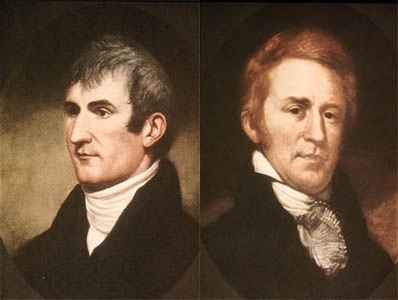
Saturday, November 24. Some people have just arrived from Montagne a la Basse, with a letter from Mr. Chaboillez, who informs me, that two Captains, Clarke and Lewis, with one hundred and eighty soldiers, have arrived at the Mandan Village on the Missouri River, which place is situated about three days' march distant from the residence of Mr. Chaboillez. They have invited Mr. Chaboillez to visit them. It is said, that on their arrival, they hoisted the American flag, and informed the Natives that their object was not to trade, but merely to ex plore the country; and -that as soon as the navigation shall open, they design to continue their route across the Rocky Mountain, and thence descend to the Pacific Ocean. They made the Natives a few small presents, and repaired their guns, axes, &c., gratis. Mr. Chaboillez writes, that they behave honourably toward his people, who are there to trade with the Natives.

Wednesday, April 10. On the 24th ult. I set out on horse back, accompanied by one man, for Montagne a la Basse. When we arrived there, we were not a little surprised to find the fort gates shut, and about eighty tents of Crees and Assiniboins encamped in a hostile manner, around it, and threatening to massacre all the white people in it. They, in a menacing manner, threw balls over the palisades^ and told our people to gather them up, declaring that they would probably have use for them in the course of a few days. After having passed several days there, I set out to return home. Just as I had gotten out of the fort gate, three vil lainous Indians approached me, and one of them seized my horse by the bridle and stopped him, saying, that the beast belonged to him, and that he would take him from me. I told him that he had disposed of him to Mr. Chaboillez, who had charge of the post; and that of this gentleman, I had purchased him, and that I had no concern with the matter, which was wholly between him and Mr. Chaboillez. Perceiving, however, that he was determined not to let go of the bridle, I gave him a smart blow on his hand, with the butt end of my whip, which consisted of a deer's horn, and instantly striking my horse, I caused him to spring forward, and leave the Indian behind. Finding myself thus clear of this fellow, I continued my rout; but he with one of his companions, followed us nearly half of the day, if not longer. After this length of time we saw no more of them. Apprehensive, however, that they might fall upon us in our encampment at night, and steal our horses, and probably massacre us, after it became dark, we went a little out of the path, and laid ourselves down; but we dared not make a fire, lest the light or the smoke should discover the place where we were.

While at Montague a la Basse, Mr. Chaboillez, induced me to consent to undertake a long and arduous tour of discovery. I am to leave that place, about the beginning of June, accompanied by six or seven Canadians, and by two or three Indians. The first place, at which we shall stop, will be the Mandan Village, on the Missouri River. Thence, we shall steer our course towards the Rocky Mountain, accompanied by a number of the Mandan Indians, who proceed in that direction every spring, to meet and trade with another tribe of Indians, who reside on the other side of the Rocky Mountain. It is expected that we shall return from our excursion, in the month of November next. [This journey, I never undertook; for soon after the plan of it was settled, my health became so much impaired, that I was under the necessity of proceeding to Head Quarters, to procure medical assistance. A Mr. La Rocque attempted to make this tour; but went no farther than the Mandan Village.]

See LaRoque's Journal of a Voyage to the Rocky Mountains


Monday, 27. Riviere a la Souris, or Mouse River. This is about fifty miles from Montagne a la Basse. Here are three establishments, formed severally by the North West, X. Y. and Hudson Bay companies. Last evening, Mr. Chaboillez invited the people of the other two forts to a dance; and we had a real North West country ball. When three fourths of the people had drunk so much, as to be incapable of walking straightly, the other fourth thought it time to put an end to the ball, or rather bawl. This morning, we were invited to breakfast at the Hudson Bay House, with a Mr. McKay, and in the evening to a dance. This, however, ended more decently, than the one of the preceding evening.

Monday, August 3. First long Portage in the Nipigon Road. We yesterday, separated from Messrs. Chaboillez and Leith, who have gone to winter at the Pic and Michipcotton; and to day, we left Lake Superiour, and have come up a small river.

Tuesday, October 01, 1985

Lisette Duval (Laval) Harmon 1791-1862

"...my cherished companion and the mother of my children" --Daniel Harmon

Elizabeth Laval, or Duval, was the Métis "daughter of a French-Canadian voyageur and a woman of the Snare people, whose country lies along the Rocky Mountain." She was born circa 1791 in the western Canadian Rockies. At the age of 14, Lisette was given as a "country wife" or femme du pays to Daniel Harmon "à la façon du pays" (in the custom of the country, or in common law) at South Branch Fort, Saskatchewan, on October 10, 1805. She traveled to the prairies and British Columbia for a decade with Daniel, and returned from Fraser Lake, BC to Vermont with him and their two surviving daughters in the spring of 1819.


Lisette and Daniel were formally married in the church of NorthWest Company headquarters at Fort William on August 19, 1819. Her son John was born on August 24, and the family departed for Montreal two days later. They arrived in Vergennes, Vermont, on September 11, having made a canoe trip of some four thousand miles in eleven weeks with three small children including a newborn. Lisette eventually bore fourteen children, ten surviving infancy; she buried all but two, as well as her husband. She died at Sault-au-Recollet, Montreal, February 14, 1862 aged 70, and is buried in Lot G-11 of Mount Royal Cemetery.

Thursday, January 01, 1970

Daniel Williams Harmon 1778-1843

Daniel Williams Harmon was born in Bennington, Vermont (then part of New York) on February 19, 1778. The fourth son of a tavernkeeper who had fought on the American side in the Battle of Bennington, Daniel joined the North West Company in the spring of 1800 at the tender age of 22.

Daniel Williams Harmon was a moral man whose passions were conversation, religion, and family. He was intense but not an intellectual, intelligent but not educated. Though one of his brothers went to Dartmouth, Daniel was cut from rougher cloth. The Reverend Daniel Haskell, editor of Daniel's journal, bemoans the fur trader's lack of a classical education as it shows through in his rough writing style. Nicknamed "the priest" by his Canadian companions, Daniel was passionately spiritual, intensely reserved, and extremely hard on himself. Each birthday in his journal finds him condemning his life of "folly and sin," though apart from one or two occasions where he admits to being "three sheets to the wind," it is hard to find evidence of his transgressions. He was serious, earnest and responsible, and inclined to be dry, especially without the society he craved. This was the society of close friends and their books, and his journal constantly laments the lack of good conversation especially about religion. He missed his family intensely, and yearned for their letters; we can only regret that none of his survived.

After a nineteen-year career as a clerk and company factor in the Canadian northwest, Daniel retired from the NWC in 1819 and returned to his native Vermont. The event that has perhaps most distinguished this otherwise typical fur trader's career was his decision to bring with him his mixed-blood wife and children.


With his brothers Argalus and Calvin, Daniel founded the town of Harmonville, later Coventry, Vermont, in 1824, where he kept a trading post and sawmill on the Black River. The family returned to Montreal in the spring of 1843, where Daniel died weeks after the move in March, aged 65. No formal record of his death is known, though he is presumed buried in Montreal. The Harmon family monument in Mount Royal Cemetery is near the grave of his contemporary, the famous Canadian cartographer David Thompson.